

Federal District Court Invalidates Process for Assessing ACA Penalties
A recent federal court decision has created uncertainty regarding the process for assessing employer shared responsibility (or “pay-or-play”) penalties under the Affordable Care Act (ACA). On April 10, 2025, the U.S. District Court for the Northern District of Texas held that the IRS cannot assess pay-or-play penalties without the U.S. Department of Health and Human Services (HHS) first providing the employer with a certification. Currently, the IRS uses Letter 226-J to notify employers that they may be liable for a pay-or-play penalty without prior certification from HHS.
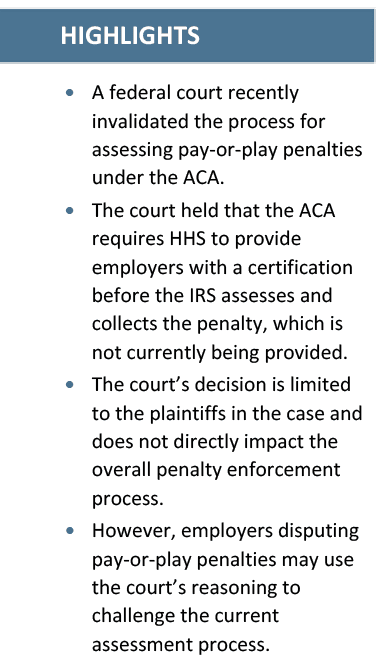 Significantly, the District Court’s ruling is limited to the plaintiff involved in the lawsuit and does not directly impact the overall enforcement of pay-or-play penalties. However, employers disputing these penalties may use this decision’s reasoning to support an argument that the current assessment process is invalid. Note that the general deadline for filing a refund claim is three years from the tax return filing date or two years after paying the tax, whichever is later. Also, it is uncertain if the Trump administration will appeal this decision and how vigorously it will enforce pay-or-play penalties going forward.
Pay-or-Play Penalties
The ACA requires applicable large employers (ALEs) to offer affordable, minimum-value health coverage to their full-time employees or potentially pay a penalty to the IRS. ALEs are employers that employ, on average, at least 50 full-time employees, including full-time equivalent employees, during the preceding calendar year.
An ALE will face a penalty if one or more full-time employees obtain a subsidy for health insurance coverage purchased through an ACA Exchange (or Marketplace). An individual may be eligible for a subsidy either because the ALE does not offer coverage or offers coverage that is unaffordable or does not provide minimum value.
District Court Ruling
The plaintiff, a Texas-based company providing janitorial services to schools, sought a refund of the pay-or-play penalty it paid to the IRS for 2019. In doing so, the employer argued that the penalty collection process was flawed because the ACA’s statutory text first requires HHS to provide ALEs with a certification as to their potential liability and a notice of appeal rights. Once HHS certifies that an ALE owes a pay-or-play penalty, the IRS has the obligation to assess and collect the penalty. To streamline the assessment process, HHS delegated authority to the IRS to provide the certification required to assess a pay-or-play penalty. The IRS uses Letter 226-J as the penalty certification.
The District Court ruled in the plaintiff’s favor and ordered the IRS to refund the penalty assessed for 2019. The court also invalidated HHS’ delegation of the certification authority to the IRS, holding that the ACA’s statutory text does not permit such delegation.
This Legal Update is not intended to be exhaustive nor should any discussion or opinions be construed as legal advice. Readers should contact legal counsel for legal advice. ©2025 Zywave, Inc. All rights reserved.