

Health savings accounts (HSAs) are a popular type of tax-advantaged medical savings account available to individuals enrolled in high deductible health plans (HDHPs). Individuals can use their HSAs to pay for expenses covered under an HDHP until their deductible has been met, or they can use their HSAs to pay for qualified medical expenses that are not covered under the HDHP, such as dental or vision expenses.
HSAs provide a triple tax advantage: Contributions, interest or earnings, and amounts distributed for qualified medical expenses are all exempt from federal income tax, Social Security/Medicare tax and most state income taxes. Due to an HSA’s potential tax savings, federal tax law includes strict rules for HSAs, including limits on annual contributions and HDHP cost sharing.
HSAs are individually owned accounts, which means that individuals keep their HSAs even if they switch jobs or change their health plan coverage. Also, since there is no deadline for spending HSA money, individuals can use HSAs to save for future medical expenses.
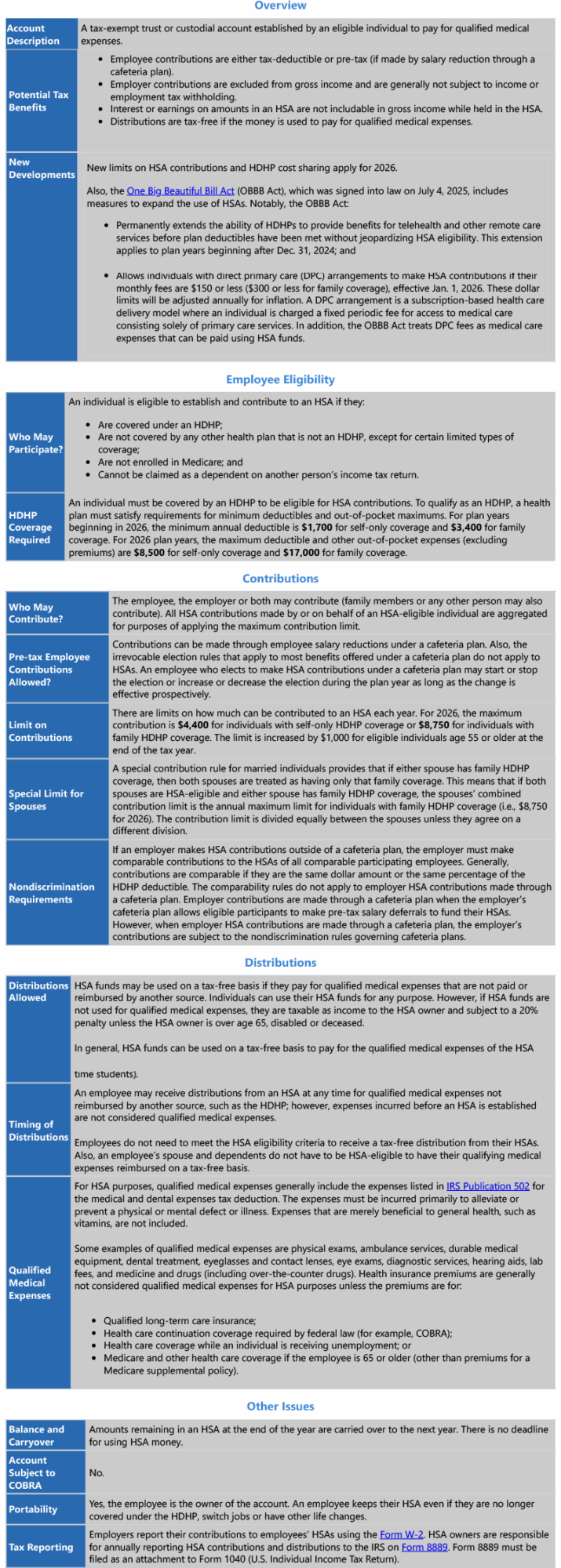
This Compliance Overview summarizes key features for HSAs for 2026.
Key Features At a Glance
Links & Resources
- IRS Publication 969 – HSAs and Other Tax-Favored Health Plans
- IRS Rev. Proc. 2025-19 – HSA Limits for 2026
Provided to you by Hodge, Hart & Schleifer
This Compliance Overview is not intended to be exhaustive nor should any discussion or opinions be construed as legal advice. Readers should contact legal counsel for legal advice. © 2025 Zywave, Inc. All rights reserved.